Route in short:
Barcelona (flight, €39.16) > Pamplona Airport (taxi, €14.20) > Pamplona Bus Station (bus, €5) > Roncesvalles (taxi, €50) > Saint-Jean-Pied-de-Port.
10.30am–4.30pm (6 hours), €108.36.
–
I usually prefer trains when I’m in Europe (well-connected, less emissions) but couldn’t find connecting trains available from Barcelona to Pamplona/Roncesvalles/Saint-Jean-Pied-de-Port, probably because it was the new year season.
I was lucky to find a direct flight in the morning from Barcelona to Pamplona from Iberia Airlines for €39.16. They gave me a right-side window seat. Seeing the snow-capped tips of The Pyrenees range poking through the cloud cover did inspire some feeling. I landed at about 11.30am.
At Pamplona Airport, there’s not really any public transit to the bus station, so I took a taxi waiting outside the airport to the city bus station which cost €14.20. At this point, my basic Spanish was starting to be important.
The Pamplona bus station is pretty small and straightforward. There’s a few ticket counters, and I went to counter 3 which had a sign for “Roncesvalles”. The counter staff shared that the bus would leave at 1.50pm at platform 21–24, and would cost €5, to be paid on the bus.
So the morning flight was a blessing, making me arrive early for the connecting bus, so I had some time. I ate a chorizo sandwich from the only food shop there.
The bus turned out to be a really comfortable mini-bus by Artieda, with only a few passengers. They left almost immediately, so if you want to catch this bus, don’t be late.
I was expecting to arrive at Roncesvalles with taxis waiting, as some guides said they would, and to hopefully meet pilgrims on the bus to share it with. Strangely, no taxis were there, and some passengers that looked like pilgrims rushed off somewhere else before I could propose to share one.
Baffled, I walked a bit and found the tourist office, and was told I could get a taxi from one of five numbers on a piece of paper on their noticeboard (the same paper was also on the door of the neighbouring bar, so maybe this driver collective owns the transport route). It’s perhaps possible to contact these drivers in advance to maybe even take you from Pamplona (the first driver we called said he was all the way there).
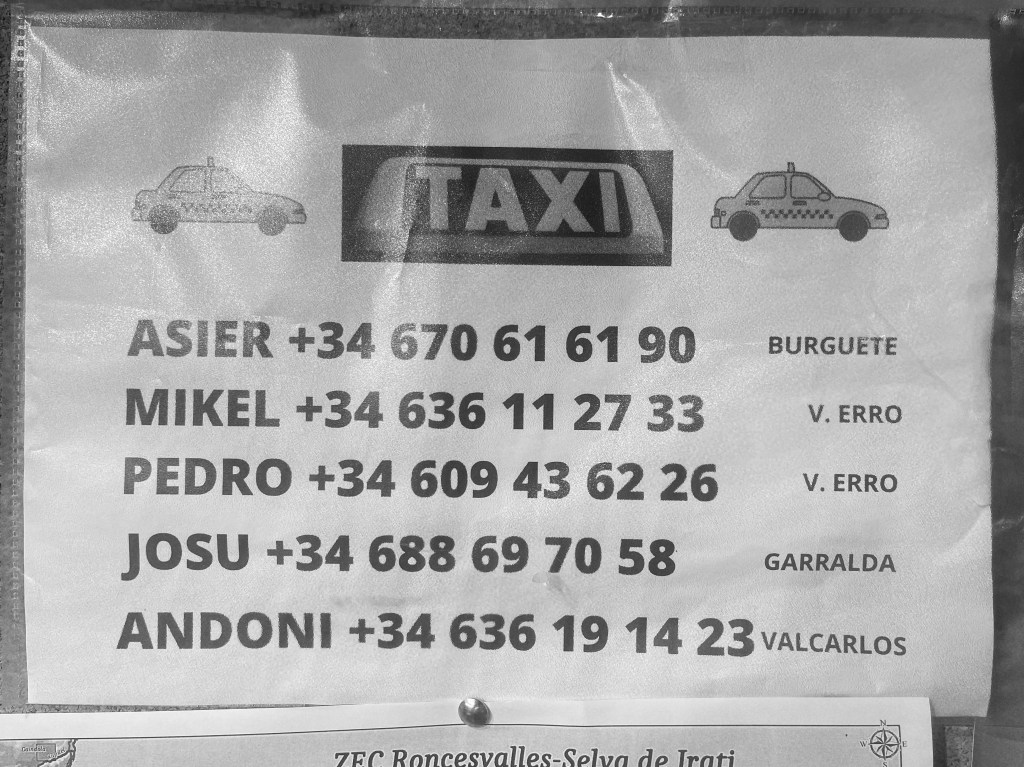
The second call we tried (thank God they all use WhatsApp, I only had data) got me a driver, Pedro, that was only 20 minutes away. We attempted some small talk with my limited Spanish and his limited English but most of the trip was quiet. As we drove across the French border, the landscape started to get hilly which gave a nice mood.
The taxi turned out to be a whopping €50, probably the most expensive I’ve ever paid for in my life. I guess during the on-season you can usually find fellow pilgrims to share it with, and this was a risk I took. A quick search online also confirmed that it’s a pretty normal rate for this trip. I was probably covering his return trip back too as he was unlikely to find a passenger.
I could have technically started the route from Roncesvalles or Pamplona (these are stops on the Camino I would be walking back towards) and save a lot more money that I spent to get here, but there’s a palpable anticipation to starting the journey at Saint-Jean-Pied-de-Port that I feel here in the albergue. People are settling into their bed areas, reading the notes from the pilgrim’s office, getting some prep in place, and generally still looking fresh. It feels like a starting point, not a stop. The albergue is surprisingly filling up on a day I thought I’d see no one (no one mentioned they were starting today on the forum).
Anyway, I alighted at the entrance of some kind of castle street on a hill and walked a bit to the pilgrim’s office. There is a lady who speaks less English that was happy to hear my little French words, but it’s a man who speaks fluent English that entertained me mostly. I filled my details, and they gave me a credencial and my first stamp, alongside instructions for tomorrow’s route, a list of albergues, and a profile map of the various stages. At the side, I picked out a scallop shell (the symbol of the Camino de Santiago) to hang on my bag in exchange for a donation of any amount.
After putting my bags down in the nearby albergue (which happens to have a great view of the town), I left immediately to get a hiking pole as the sun was setting. I wanted a budget hiking pole that didn’t feel too lousy and was light, and at Maya Sport I found an aluminium one called “Wanabee Hike 300” for €22.90 that was about 260g. While the carbon fibre Leki poles looked great, I wasn’t going to fly back with poles, so I didn’t want to spend too much. Oh Decathlon, wish you were here. And hot tip: if you’re getting sports equipment from Maya Sport, it would be a great time to pop into the Carrefour opposite for some groceries for your dinner tonight. Unfortunately I made the mistake of returning first with the pole then deciding to do dinner, so I walked down the hill again.
So far I’ve met a few people at the albergue. A genial Korean guy, Ji Sung, offered some of us Fererro Rocher, and he also gave me chorizo he realised wasn’t to his taste. A Korean girl called Areum (I walked in to four Koreans, by the way) gave me a couple of oranges. I sat down to my dinner with an Italian guy called Max who looked really tired. Turns out he had already cycled all the way from home, and this was a stop after two months on the road.
I’m glad that I managed to get here within a day from Barcelona. Tomorrow it begins.
 Jeremy Walks the Camino in Winter
Leave a comment